Calling this a popular science article is a stretch. There is no rigorous experimental design here, no systematic literature review. Calling it a book review would be too sentimental — I did not read with my heart on my sleeve, and most of it slipped away after I turned the last page.
I spent my undergraduate years working on Japanese eels with my advisor. The project fizzled out when the department stopped providing lab space, but two-plus years of messing about with eels was enough to leave me with a feeling about this creature that I can't quite put into words.
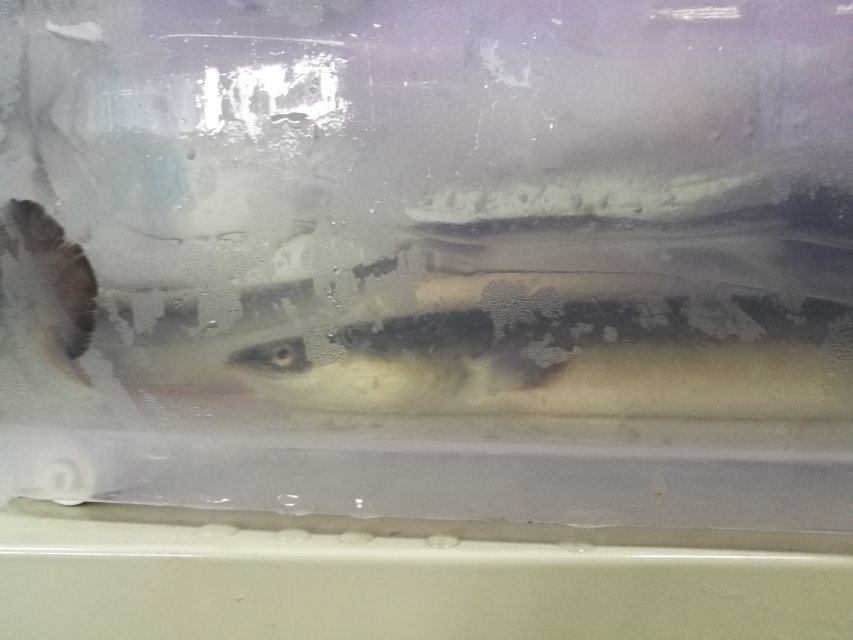
Frozen adult eel (photographed in Quanzhou, Fujian, 2018)
Dissections, injections, surgeries, tissue sections, cell observations — those wet-lab days are still vivid in my mind.
Keeping fish alive is not really about manual dexterity. It is about understanding animal physiology. You have to know when to raise the temperature, when to change the water, when to feed them, and what it looks like when an eel is not feeling well.
Sounds like keeping a pet, except no pet requires you to give it injections.
What is interesting is that eels always carry an air of mystery. This impression does not come from textbooks — it comes from actually spending time with them and realizing how many things about this animal simply defy explanation.
Mystery Is the Defining Trait of Eels
An eel goes through multiple metamorphoses in its lifetime. It starts as a leaf-like leptocephalus larva hatched at sea, turns into a glass-clear glass eel, then becomes a yellow eel in the river, and finally transforms into a silver eel that silver-bright, makes its way back to spawn. A single life passing through so many complete physical transformations is exceedingly rare among vertebrates.
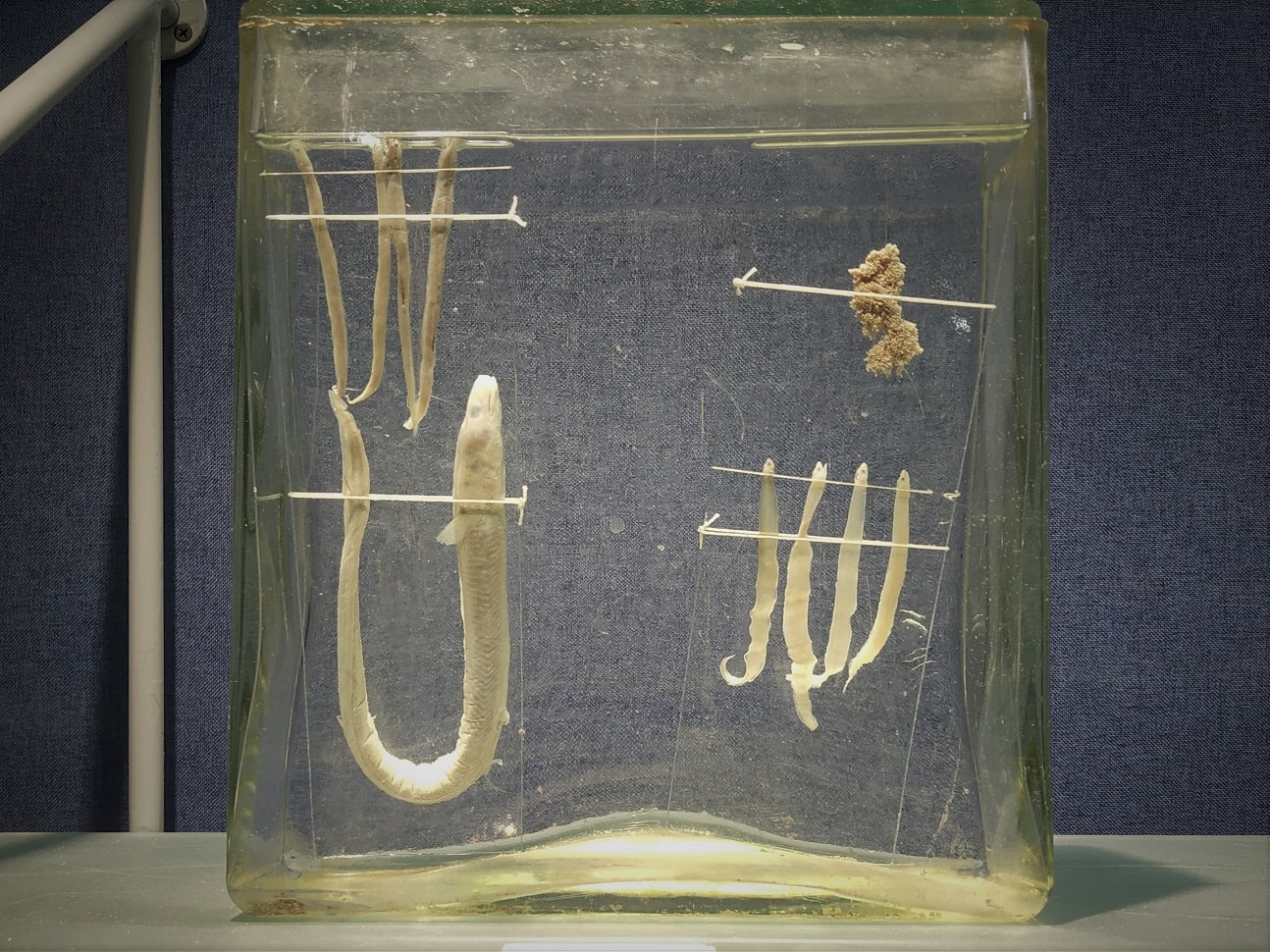
Developing juvenile eel (photographed in Dalian, Liaoning, 2022)
But what truly fascinates me is not the metamorphosis itself — it is the unsolved mysteries behind it.
For example: how do eels find their way home?
Scientists have proposed a good number of hypotheses: the Earth's magnetic field, olfactory navigation, acoustic cues. All sound plausible, but honestly, we still do not know. How do they pinpoint the exact river they were born in, across vast stretches of ocean? No one knows for sure.
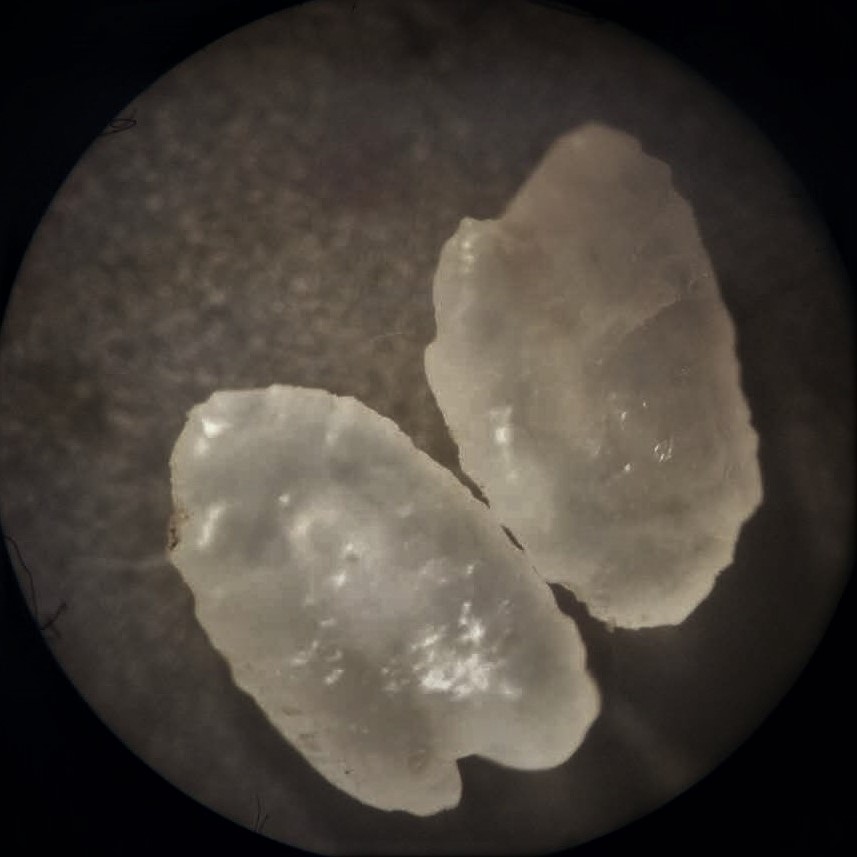
Japanese eel otolith (photographed in Quanzhou, Fujian, 2017)
There is an anecdote from the book that stuck with me: someone caught eels, released them several kilometers away, and a week or two later, they found their way back to the exact spot where they were first captured.
My advisor, Professor Cheng, said eels have built-in radar.
Maybe.
And then there is the question: where exactly do they spawn?
The spawning grounds for European and American eels are more or less settled — the Sargasso Sea in the Atlantic. But for Japanese eels, scientists have been arguing for years. One theory points to the waters near the Mariana Islands. There may be other possibilities. The Mariana Islands.
Of Eels and Enchantment
What makes The Book of Eels compelling is that it does not try to lecture you on biology. The author, Patrik Svensson, is Swedish, and he weaves together eel history, biology, philosophy, and even his own childhood memories into a seamless blend.
The book mentions a curious detail: Aristotle once believed that eels were spontaneously generated from mud. He advised people to observe a dried-up pond during a drought. When the first rain came and slowly refilled the pond, it would suddenly be teeming with eels — "the rain had given them existence."
We now know this is wrong. But in an era without microscopes, without experimental methods, the guess was not unreasonable. What is more interesting is that thousands of years later, armed with far more advanced technology, eels still manage to baffle us.
The book also notes that the eel question has existed "for as long as the history of natural science." A fish we see every day in markets and on dinner tables has managed to keep its reproduction hidden. That sounds almost ironic, but it also shows that nature's complexity runs far deeper than our understanding.
I sometimes wonder: what happened to the eels we kept in the lab during those two undergraduate years?
Most likely they gave their lives to science. They were certainly not released back into the wild.
It did not end the way I had hoped.
I switched directions later. After graduation, I never touched an eel again.
A year or two later, I stumbled upon this book. It did stir up some old memories, but that was about it.
The book cites the philosopher Thomas Nagel's famous 1974 essay, "What Is It Like to Be a Bat?" The same question can be asked of eels: what is it like to be an eel?
We have tried every method — genetics, hormones, trackers, satellite positioning — but do we truly understand them?
I do not know.
But sometimes I think it is precisely this "not knowing" that makes eels interesting.
If you are curious about this mysterious creature, or just want a book to while away an afternoon, The Book of Eels is worth reading. It will not tell you what an eel is — because no one knows. It will only tell you how mysterious eels are, and how much effort humanity has poured into cracking that mystery.